Saturday, 28 August 2010

BARBARA’S SOUTH AMERICAN ODYSSEY PT 2

Monday April 26th
When I last wrote, we were in Buenos Aires. That was day nine of our travels. On the morning of day ten we had to be up fairly early in time to breakfast, pack and transfer back to the airport for our next flight, this time with LAN airways to Lima, capital of Peru. After a three hour flight we arrived and checked into a hotel. Although we would be in Peru for several days, we had only one afternoon in Lima so we had to make the most of it, via an organized tour.
This was conducted by a very cute looking young guide.
Lima lies on the Pacific coast. It was founded back in the sixteenth century and eventually became the centre of all Spanish trade and culture in the New World. So as you can imagine it abounds with colonial architecture, and old Spanish style churches as well as modern residential areas.
Our tour focused very much on the colonial aspects of the city.
And while we were looking at these buildings our guide brought us up to date on life in modern day Peru. It seems that the President is none too popular, as is the case in Argentina. Quite a few South American countries point to Chile’s former president Michelle Bachelet as a model president.
There are apparently no social services here. You either have a job or you starve unless your family can support you. Hospitals have long waiting lists and the education system provides only the teacher and the building. The rest is up to the parents.
There’s very little rain in Lima but the city gets its water from the melting snow in the Andes.
There's a history, geography and politics lesson in two minutes.
Our tour took us to some of those typically Spanish style churches filled with statues and mosaics and with so much gold leaf it was almost obscene, especially in such a poor country.
We visited the Cathedral, and a beautiful cream colored colonial building called the Convento or Monastery of San Francisco, the main city square
“Plaza Mayor”, and then on to the Rafael Larco Herrera Museum for our first taste of Inca and pre-Inca culture. 
This museum has one of the largest collections of gold and silver produced in ancient Peru, as well as a fascinating array of ceramic pottery. 
Some of this comes from the Moche culture which pre-dates the Incas. 
Incan art
Moche carving
Incan art


Tuesday April 27th
The next morning saw us back at the airport and boarding a flight to Cuzco, a city in the mountains about an hour away. 
Over the Andes to Cuzco
Landing at Cuzco airport, reminded me of coming into Cairns. You have to fly around the city which is surrounded by mountains, until you line-up with the runway, then close your eyes and pray.
Cuzco was once the centre of Incan civilization. That culture only lasted 300 years but there is plenty of evidence of it still around.
Many of the streets are lined with Inca stonework, still serving as foundations for more modern buildings.
You need a bit of time to acclimatize here, because you are 3,300 metres above sea level and the air is quite a bit thinner. Visitors do get altitude sickness and we were told that most hotels provide oxygen on request if you are really sick.
Fortunately I didn’t get altitude sickness although one or two of my fellow travellers weren’t so lucky.
Once rested we spent the afternoon exploring this beautiful old city. Of course there is the obligatory Plaza and Cathedral but there were also Inca ruins and we would explore these on the following day.

Wednesday April 28th
Giant basalt blocks
The Spaniards knocked a lot of things down when they first arrived. Incan temples were demolished and replaced with Christian churches. But you can still see enough of the ruins to realize that the Incas were great engineers. They used huge basalt blocks  and built enormous structure without ever using mortar. They simply built everything at a slight angle, so each block leant on the next to keep upright. 


Incan architecture
They also employed a sort of jigsaw pattern of building. They were so accurate that even today you could not slip a razor blade between the blocks.
Once again a visit to the cathedral is like a visit to an Aladdin’s cave of precious jewels and gold and silver. We were told that the owner of a silver mine actually donated silver by the tonne for the construction of altars.

Thursday April 29th
Every June in Cuzco on the feast of Corpus Christi They take one of these altars out in procession. They used to carry it but now it sits on an army jeep in the church and they drive it about the city on the jeep.
They love processions here. 

Another procession

We were sitting in the park having lunch when this young boy came up trying to sell us crocheted llamas and other finger puppet animals. His English was pretty good so I asked him why he wasn't at school. He told me his teacher (Australian or English called Pedro,) was absent. The boy’s name was Alfredo.
Just as Malcolm, one of our group was about to buy something, Alfredo hid his the article under his bag, saying something about “the policia”.
When the policeman moved away, it was back to business.I asked Alfredo if he would be going back to school on the next day but he thought it was Saturday and he would return on Monday.
Given that his English was so good; his education seemed to be doing him some good.
In Cuzco we visited lots of Inca sites, and museums, as well as the factory where they produce llama jumpers. When they sell llama jumpers or hats in the street they tell you it is “baby llama”, but what they are actually saying is “maybe llama”.
A few of us bought stuff from street vendors. It was so cheap that it was worth it even if it only lasted a day or two.
I bought some good quality things but I also bought a jumper from a street seller because I was freezing.
Just like Melbourne, Cuzco weather can be hot one minute and cold the next.
Street vendors
Friday April 30th
From Cuzco were travelled out of the city. This meant firstly a bus ride to the town of Piscacucho, a short walk to a makeshift railway station built after the mudslides, and then by train to a place called Aguas Calientes.
The countryside surrounding Cuzco is very mountainous and many of the houses we passed looked very unstable. Our guide told us these places were around 70 years old, but we think they fall down every 70 years and they just rebuild them each time. 
The road was very rough in the wake of the landslides they had recently endured. The railway station was only just rebuilt too.
All along the railway line we could see evidence of the landslides and they must have worked really hard to get things going again. Tourism is obviously very important to them.
Wild river & mudslide

We reached Aguas Calientes  and stopped for the night and had dinner in our hotel which was just as well as I was feeling pretty crook with a cold that wouldn’t go away. Tomorrow we would set off by bus for Machu Picchu. No-one was prepared to take the trek which would have meant getting up at 4.30 am.

Saturday May 1st
 Up at 8 am to travel to Machu Picchu by bus. There was a line of them waiting for us and all the other tourists. Our bus was tenth in the queue. Three thousand people visit Machu Picchu every day so you can imagine how hectic it is.
Machu Picchu is only a short distance away as the crow flies, but the place is quite high up and access is along a tortuous narrow road with a series of elbow bends. From above it must look like a kids’ set of toy buses winding its way up the mountain. But then the first buses in line start to come down again and there are very few places to pass. So follows much reversing and breath holding while our bus gets perilously close to the edge of the road. And all the time you can see the river winding away below as it rushes down the mountainside.
But in the end we reached Machu Picchu itself and the journey was well worth it.
Machu Picchu
Once off the bus we walk slowly up the terraces of this amazing place.
How the Incas managed to construct this enormous space beggars belief. It lies spread out beneath a gigantic thrusting peak of almost bare rock shrouded in mist. Looking down you can see deep green and misty valleys dropping hundreds of metres to a boiling river torrent. 
For centuries this place was buried in the Peruvian jungle until an American historian, Hiram Bingham accidentally discovered it in 1911.  You can only marvel at the remains of temples and ornamental sites which seem to go on for ever.The whole archeological complex covers about 5 square kilometres.
Inca ruins

The word Picchu means mountain, and Machu - old. While the real purpose of the site is not fully understood it is obvious that it was a communal living area.  The terraces were used to grow crops and the buildings were for living and worship. They even had a sewerage system in which dirty water was separated from drinking water. The whole complex took a hundred years to build and it is still standing four centuries later. There are lots of hiking options here but none of us were very adventurous. Some went as far as the Sun Gate higher up the mountain.
There were only a couple of unpleasant incidents during our visit. One of our group, Jill, had been suffering from the altitude, but was determined to make the journey. Half an hour after we arrived on the site, she became really ill and had to be stretchered out. It gave us all a nasty shock to see Jill looking so deathly pale.
But we pushed on up the terraces as cloud was starting to close in on us.
It was then that I took my eye off the path and stumbled and fell. As I lay on the ground a rather spunky bloke in an Arsenal tracksuit came to my aid and checked me out. He gave me the all clear and then another spunky bloke, an Italian, helped me down the rest of the steps. All I had was a grazed shin and some bruises, but all that attention made it all worthwhile.
Then followed that long bus line back to our hotel!  By the time we reached it, the rain was pouring down.
After dinner we headed off up the hill to the railway station at Aguas Calientes and on to the Vistadome train for the journey back to Piscacucho. From there we took a bus to a place called Ollantaytambo, which is in the Sacred Valley. 
Finally in the dark we arrived at the Pakaritampu Hotel. Even in the dark it looked interesting but we couldn't see much and were too tired anyway.
Sunday May 2nd
Pakaritampu Hotel, Ollantaytambo
When we awoke the next morning we could see how beautiful our hotel was.   It was a real hacienda with a lovely garden, and to my great surprise, there on the lawn in front of me were three llamas having their breakfast. After our own breakfast we set out for the Sacred Valley to inspect yet more brilliantly built Inca ruins. To the west of the city is a mountain scattered with houses and innumerable pre-Hispanic temples and terraces.
Handicraft shop
From there we visited a South American Indian town called Chinchero and another called Pisac. Here there were marketplaces where local Indians from different communities trade their goods either for money or by bartering. Lots of local handicrafts! 
From our bus we also observed something of the local sanitary practices. Basically it was a matter of doing it in the street. I saw one man using both hands in case he splashed his shoes. And there was an old lady who squatted on the roadside, simply walking away from the evidence when she’d finished.
At the end of the day we arrived back in Cuzco and another night in my small hotel room.
 Monday May  3rd
Next day and we were heading south from Cuzco to Puno on a great train journey. One of the highlights of the trip is to watch one of our group, Rod, who is the original train buff. He was as excited as a three year old, running up and down the station taking photos of every aspect of the R Class or STJ or whatever the engines, carriages or rail lines are called.
Children by the railway track 

Waving to the tourists
The train, The Andean Explorer is delightful. All the tables have two benches, old fashioned lamp shades and a small vase of flowers, Afternoon tea is served at the table, and pre dinner drinks. This is the sort of luxury I could get used to.  At the end of the train is a glass walled observation car.
Along the way again we saw a variety of landscapes and small villages. The train stopped for a short time at La Raya which is 4317 metres above sea level. There is a market there, and of course a little chapel. I walked about 50 metres along the station but that was enough as I was puffing and panting in that short distance.As we came into Puno we saw loads of stalls selling every sort of car part imagineable, like a sort of auto swap meet. Puno lies on the shores of Lake Titicaca. But I'll tell you about that in my next report.


Monday, 19 July 2010

BARBARA'S SOUTH AMERICAN ODYSSEY


The following entries are from the diary I kept of my South American trip.
Firstly can I point out that I am travelling for the first time by myself and so I have to do all the things like blogging and snapping that Damien usually does. I am neither a professional writer nor a professional photographer so please don´t expect too much.


FROM AUCKLAND TO BUENOS AIRES
At least this trip started gently with a short flight to Auckland , only 3 and a bit hours in the plane and into a country where they speak a language that is not too different from my native tongue.
There´s not much to say about Auckland. It´s a city but not really a "thriving metropolis". On Saturday 8 of us walked around looking for somewhere decent to have breakfast. It´s hard to imaging, coming from a city like Melbourne, having trouble finding a reasonable breakfast bar, but we walked the streets of Auckland , obviously in the wrong direction looking for food. Finally we found some eggs Benedict without lamb and some coffee that was not to die for!!

Then we split up and half went shopping through the few shops that were open while the rest of us hopped on a ferry to a place called Devonport, no not Tasmania.

It´s a beautiful little township in an obviously wealthy area - more BMW's per square foot than Toorak. The residences are either very cute weatherboard ones or stunning new apartments overlooking the bay. I think that they had escaped from Sydney Harbour.

Back to the airport on Saturday pm for a flight to Santiago. So we´d had breakfast in Auckland city, lunch at Auckland airport, dinner on the plane when we crossed the international dateline and started Saturday again - breakfast on the plane, lunch at Santiago Airport and dinner later that day in Santiago city. I was slim and sylphlike before that Saturday but NOW well!!!

SANTIAGO. April 17th
On first impression this place appears to be a charming colonial city with nice, wide, tree lined streets but as we wandered further through the city we found lots of boring glass boxes. We didn’t spend long here but we did the obvious tourist sites of the Presidential Palace and up and down 11th September Ave. Chile’s 9/11 is not the same as the USA’s. It is the anniversary of the Pinochet takeover (1973?) In the palace Square there is a monument to Allende who was ousted by Pinochet.
According to our guide, who seemed to have a bit of a leftist bent, Allende suicided in the palace because he said if he couldn’t lead his people he might as well be dead. The story goes that Pinochet offered him a flight from the country but everyone knew that it would not stay in the air for long. So the choice was kill or be killed.
The scary thing is that there is another right wing president in government at the moment and most of the people are desperate to return the previous incumbent. They can only serve one term so they have to wait until the current term finishes. The president at the moment is one of the owners of Lan Airlines.
Back on the plane, yes Lan airlines, to Rio via Sao Paulo.


RIO DE JANEIRO. April 19th
Thank God we have a few hours rest. Rod (one of our group) rang at 9:15 am to see what we were doing for the day and woke us up.
Before we could do any sight seeing we had to get some money. Here I have this safe travel account kindly provided by the Commonwealth bank; so safe that I can’t get money from any of the regular banks here. One way to curtail your spending!! In the process of finding the ” right bank” we were assisted by a charming guy who had a history like nothing on earth. He had been born in Israel, grown up in Egypt, then moved to Liverpool and finally came to Rio. His skin colour didn’t really back up his story but he was charming and it was entertaining to listen to his scouse accent. All the time I was thinking "why is this guy being so helpful ?" Eventually I found out; he was touting for customers for a jewellery shop. He didn’t have any luck as he didn’t get us to the right bank so we had no money to buy his outrageously priced jewellery. Finally the front desk manager at the hotel directed us to the HSBC and we solved the problem.
In the afternoon we drove through downtown Rio to see all sorts of sights including the new cathedral. It’s quite spectacular, built almost like a cylinder with fantastic stained glass windows panels from floor to ceiling.

The interior is very plain with only 5 statues. In front of the statue of St Sebastian there is a white Cinderella coach and a table for donations.

Should we have left a pumpkin and white mice there? Apparently on the feast of St Sebastian the statue goes into the carriage and joins the procession throughout the city. The other statues are of Sts Anne, Francis, and Mark but none of them get an airing in the city at any time.
Talking of processions we went to the area where the Carnivale is held. I guess when the party is on it is very spectacular but when it is not on, the place looks like the undercroft of the MCG. Just plain concrete stands beside a concrete driveway. I found it really hard to imagine all the colour and glamour of Carnivale when I stood amongst the concrete stands. The central area looked like a dried up drain or the path leading to a cattle yard. Yet we were told, at Carnivale time thousands turn out to dance the samba here and be judged by the public.
I have always understood that Carnivale was the celebration before Lent and that it finished prior to Ash Wednesday, but the guide explained that Carnivale now lasts for a week from the Sunday before Lent to the next weekend. I asked about the religious connection but no – there is now no religious significance in the celebration at all. Monday and Tuesday are holidays but people are supposed to go to work on Wednesday. However only a few private businesses operate on the Wednesday. Most government workers take a holiday.
Finally we went to Mt Sugar Loaf. It is so high that it needs two cable car rides to get to the top. 


Copacabana from Mt Sugarloaf
The view is stunning, you can see right across Rio. 

There was an option of a helicopter ride but I couldn’t see the point as you could see so far from the top of Mt Sugar Loaf.
Back to the hotel for a short rest and then to dinner organised by the Sth American Travel Bureau. I think it was the best ”free” meal that I ‘ve ever had, The waiters came around to the table with the meat on long skewers and sliced off what you wanted. The service didn’t seem to run out. Another 2 inches to my waist.
The next morning my fellow traveler,  Kerry and I made the effort to get up early and walk off last night’s dinner along Copacabana beach and on to Ipanema. We did discover that the girl from Ipenama of the 60’s is no longer tall and tanned and young and lovely. In the intervening years she has become – short and weathered and old and not so lovely!!They still want to show off what the boys wanted to look at 50 years ago. It’s a pity that they don’t realise how much damange can occur to the human body over 50 years.

April 20th                                                                     
According to the itinerary today is the day to visit the Christ the Redeemer statue on Concordia Mt.   You can see the statue from most areas of Rio and even though it is under renovation it is clearly visible. The renovations are not a problem as almost every building here is under "reform" because of the 2016 Olympics to be held in Rio. However, as you might expect, recent rains have caused a mudslide on the road and we can 't get to the site. As an alternative we go on the Floresta da Tijuca tour into the rain forest . Like all rain forests it is cool, green and very beautiful; similar vegetation to the Daintree.
The history of the forest is interesting as the Portuguese rulers realised in the mid 19th century that the removal of the trees had ruined the water supply to the city so they appointed a high ranking army officer to oversee the replanting. It took 13 years and 40,000 trees . One has to ask if they had the foresight to do that 150 years ago why are they ripping out the forests in Brazil today. Many of the Portuguese aristocracy lost their homes in the replanting but there are still some traces of colonial wealth including a chapel originally owned by the Mayring family who were German immigrants, and a large colonial building, now an expensive school run by the Dominican nuns. Possibly the most interesting house in the forest is the one designed and built, and for a long time inhabited by the famous architect Oscar Niemeyer. He is now 102 and still gives talks about design. There are beautiful beaches all around the coast; Copacabana and Ipanema are only 2 of them. They are the two most popular ones but nowhere near the nicest.
On the way to the forest we saw two of the largest favelas in Rio. 


Favelas are slum areas and are usually close to wealthy residential areas because they grew out of a need for the domestic workers to have somewhere to live near their employment. We had been told that we could go into the favelas but when were on our way, the guide said there was no chance of going in. I don’t think the bus would have managed it as there seemed to be only narrow roads. John, our Anglo-Italian, Rio resident guide explained that cars rarely go in there. The main form of transport is the motorbike. The favelas are fairly tightly controlled by the drug barons and until recently the police have kept away. However within the last couple of years they have gone after one of the barons, a 27 year old man. They managed to kill seven of his security guards but not the man himself. It’s believed that he has an underground bunker and the police could not find the entrance to it.
The drug lords control the favelas very well so there is no need for a police station there, but now that the government and police are trying to drive out the drug barons, they are setting up police stations in the favelas. The guide stressed that most of the people living in the favelas are hard working good people. There is very little crime associated with the areas as the drug lords do not want the police hanging around so they get rid of anyone who makes trouble. I guess it is not much different anywhere in the world.
Carl Williams, you just didn’t do it right.


IGUASSU FALLS April 21st
Iguassu Falls
These falls would have to be among the world's most magnificent spectacles. They are huge. They are simply awe inspiring. We are told  how they were formed after an earthquake which happened 120 million years ago which resulted in a gigantic canyon, through which the falls now plummet. You can view these falls from every angle, both from Argentina and Brazil. The border runs down the middle.
These pictures barely give you an appreciation of the scale of this place and the power of the water cascading downwards.

To get the best views of the falls, you have to cross and recross the Brazil-Argentine border which meant producing your passport several times. These is so much spray in the air, my passport ended up a soggy mass with the pages stuck together. To add to that we took a boat ride to the base of the falls just as the clouds burst overhead, soaking us all to the skin.

The name Iguassu means big water and believe me this water is BIG.
In fact there are 275 falls extending across a front of three kilometres


At the end of the day we  were all pretty damp but very glad we'd visited these falls. It was simply an unforgettable experience.
Gluttons for punishment, some of us went out that evening for what was supposed to be an experience of South American culture.This was at a sort of restaurant with a floor show organised by the local travel people.
The dinner was buffet style and the show featured acts from various countries,There were dancers from Brazil looking like they had come straight from Carnivale. Others appeared to go for a more Mardi Gras feel, which meant they'd removed most of their clothing. And there was lots of great Latin-American music along with acts from Mexico and Cuba. We shared our table with a an Italian couple; two very attractive parents, three small children and an au pair. We shared a bus ride home too and their hotel was right in the middle of a rainforest. We were staying at the Sheraton which was pretty ordinary compared to "The Cataracts" in the forest.

BUENOS AIRES  April 23rd

Back aboard another plane, this time flying to Buenos Aires.
This city has a strong European influence. Much of the architecture is French and there is a strong Italian cultural influence.The women are beautifully groomed and the men - just gorgeous. Of course there is poverty here but middle class life seems pretty good.. Nothing seems to start before 10am and doesn't get into full swing until lunchtime. Dinner time is around 9pm.
We did a tour of the city, especially the charming "old city"  We went to the cathedral which is very ornate. They were preparing for Mass and there were young men in black suits carrying white gowns with some sort of blue emblem. They walked in procession down the aisle. I asked the guide if they were Opus Dei and he thought they might be as Opus Dei is very big here. Next we visited the artists' area, Camino, which is very colourful and full of life. There were caricatured models of people sitting on the balconies or hanging from windows. All the artwork is very brightly coloured, even the leatherwork which is highly decorated. There are people dancing the tango in the street, and a guy pretending to be a matador. For a small fee you can be photographed with them.
We visited the Recoleta Cemetery  which is full of amazing mausoleums. There were more marble angels and crosses and statues of many and varied Santa Marias.
Some of these mausoleums are well kept and obviously awaiting new residents, others less cared for.
Among the older occupants here is Eva Peron. Apparently Juan Peron had her body embalmed but when he was ousted as President, the body was "lost" until the Peronistas got back into power and they had her buried here with her family.
Tonight is Tango Time 
Dinner and a show which is a tribute to a famous tango dancer who was killed in a plane crash.
Apparently tango steps were developed by immigrants who came to this country, mainly from Italy. Because there was a shortage of Italian women, Italian men started dancing with each other, adapting traditional Italian
dances.
Later the prostitutes picked up the style and then it caught on with the middle classes.
This show was a good demonstration of the dance as it is done today. The women wear slinky dresses with a very high slit, to enable the high kicks which are an integral part of the tango.
The venue for this show was built in 2008 but it was very much in the style of the thirties with round upstairs balconies and wall lights.
Dinner was very organised with courses of 7 entrees, 4 mains and 6 desserts, and the plates whipped away as soon as you finished. This was very much a tourist exercise. There were about 400 people there and all bussed it from their hotels.

April 25th
It's Sunday and we have a free day. We started out for a local antiques market, but then Kerry, one of our tour, dropped out. She had a cold and got tired easily. I stayed with her, arranging to meet the others later for lunch.
Kerry and I revisited the Cathedral but it was in the middle of a full on Mass, so we only stayed a while.
Then we headed for Cafe Tortoni for lunch. This a beautiful cafe opened in 1858 and retaining the charm of that time, with marble topped tables, wood paneling and etched glass And it's very friendly, something typical of Buenos Aires.
Lunch over and re-energized with good coffee, we walked to the government area where we visited the Pink Palace. This is where Eva and Juan Peron lived, but now it is only used for Cabinet meetings and the swearing in of new presidents, ministers, and for press conferences.
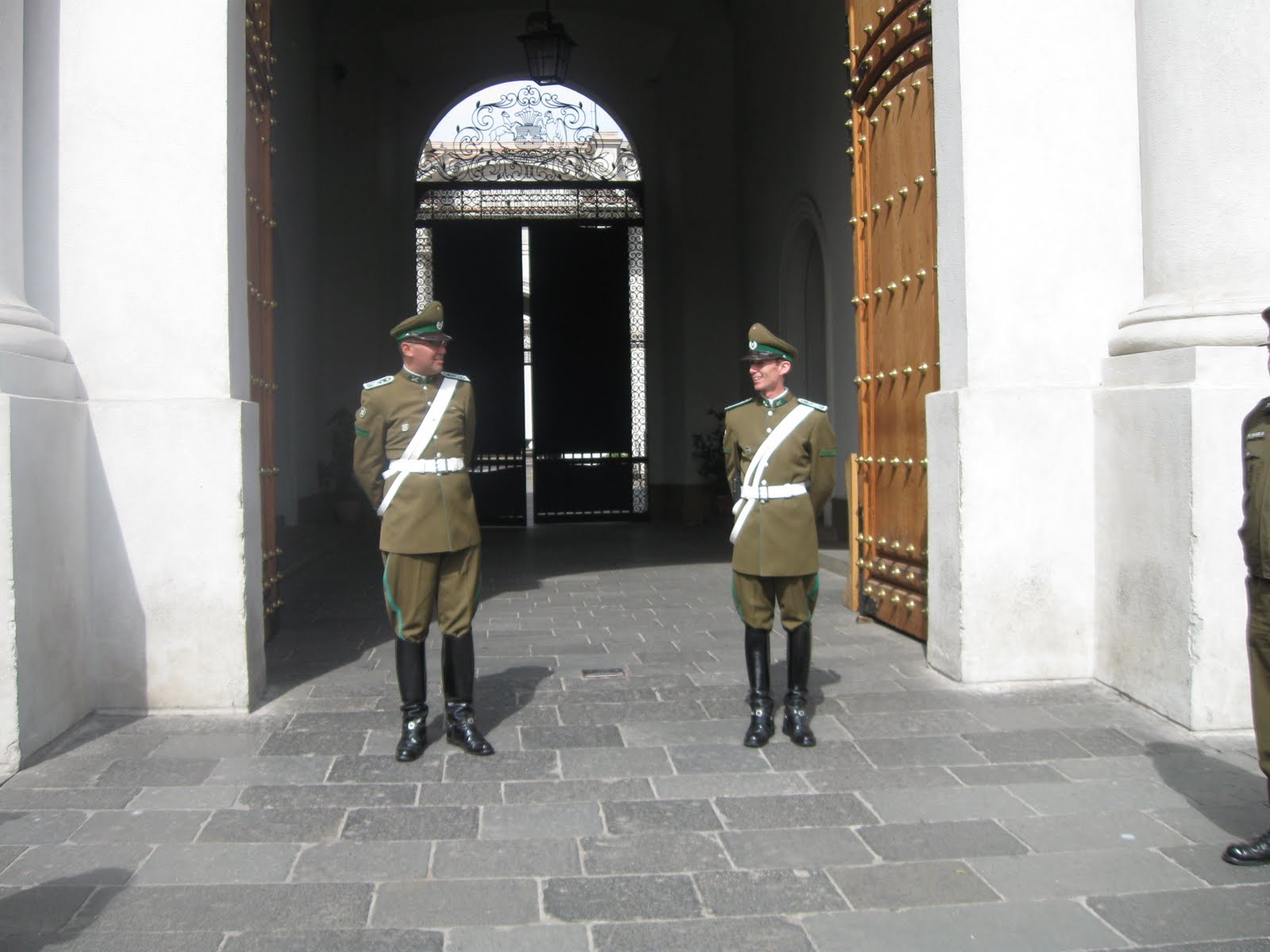
The guards wear very colourful uniforms and seem to be selected for their handsome and youthful appearance.
After that we went back to the hotel for a siesta, before visiting a church near that cemetery. There we listened to a magnificent choir. All around were altars honoring saints totally unfamiliar to me and lit with candles, their light flickering on a profusion of gold leaf adorning every one.
                                                         Dinner that evening featured among other things, roasted antelope.


Tomorrow will be an early start for Lima, Peru.


Wednesday, 2 June 2010

HOME SOON


Wednesday June 2nd

For the past few days, since we returned to London from Scotland, we have been doing very little.
We have been enjoying Fritha and Anthony's company, going out to dinner etc.
On Sunday we drove out to Beckenham in Kent where Fritha and Anthony's house is. Barbara hadn't seen it before. And we checked out the local golf course which is just down the road, and the Kent County Cricket club literally across the road from them. The house itself backs onto another cricket ground with a beautiful white painted club house and bar with chairs on a long veranda. You can see yourself sitting out there on a summer's afternoon, watching the match and sipping a pint, and occasionally clapping a well played hit. We drove then to find somewhere for lunch and found the town of Faversham. The place is quite large and busy but in the centre, just about every house is Tudor style and carries a plaque of some sort. Some relate to Henry the Eighth, another is reputed to have played host to James the Second when he was on the run.
We enjoyed a pleasant lunch in an Italian restaurant before turning again for home.
On Monday we drove to Heathrow to collect Fritha's golf clubs, which I had organised to send through a freight company.
The business of signing papers and paying agents' fees was just boring but the trip to and from the airport was like a half day tour of the city. We followed the Thames upstream out to places such as Vauxhall, Pimlico, Cheyne Walk and bits of the city we wouldn't otherwise have seen. We passed the Battersea Power Station, an architectural icon of the thirties, now a listed building but in a sad state of repair. And we passed through areas that until the 19th century would have been out in the country, but have now virtually been swallowed up by development.
Then yesterday Barbara and I took the tube to the Barbican area which lies right alongside the old walls of London city. It was a wet and fairly miserable day but we wanted to visit the London Museum. We did go there in 2008 but it has been expanded and refurbished since then. It's a museum devoted to the history of this city and has exhibits, including pre historic remains, that date back to Roman times and way beyond. You really need to spend a couple of days there to see everything properly. There are Roman relics, Saxon relics, mediaeval relics and plague and great fire relics and so on, right up to the 50's,60's and 70's. There's fashion stuff from Elizabethan times and Mary Quant, the mini-skirt and Rastafarian gear, and even a replica of a
Lyons Tea Shop with a waitress in a white starched apron and a white starched head band, serving tea and scones off those three tiered cake stands. I actually remember going to a Lyons Tea Shop in 1957.
Last night we dined at home with Fritha and Anthony and today we are packing for home. We have to be up early tomorrow to get out to Heathrow by 9.30am.
So that brings this blog to an end. We'll be back home in Emerald by the weekend, and perhaps a week after that we'll address the big question.
Where will we go next?

Friday, 28 May 2010

AWAAGH WI' THE SCOTS


Friday May 28th
I'm writing this from Lochton near Coldstream in Scottish Border country. We are staying with our good friends John and Ros Aitchison who own a farm here. We've been in Scotland since Wednesday after taking an early train from Kings Cross. Four and a half hours later we stepped onto the platform at Edinburgh's Waverley Station. We'd booked into a hotel called the Scotsman, and we were about to follow a set of directions I'd printed up, when we spotted a green door directly across the road. This was the basement entrance to our hotel. Once inside, we learned what a great choice of hotel we'd made. The building was originally the offices and press room of the Scotsman newspaper but it's been converted into a hotel with charming rooms and halls and corridors lined with oak panels and lovely old Scottish prints. The service was superb. Every staff member would greet you with a smile and say good afternoon Mr and Mrs Ryan. Once we'd settled into our room Barbara and I headed out to some exploring. This city is much smaller than London of course, and the architecture is mainly grey stone. It's very easy to navigate and we were soon on the famous Royal Mile and then to Princes Street which is dominated by a huge monument to Sir Walter Scott. There are lots of gardens and lots of double decker buses. And on street corners we passed kilted pipers playing....and playing....and playing!
Barbara and I got on one of those hop on hop off buses and took an hour long tour of the city, craning up to stare at Edinburgh Castle, and down past St Giles Cathedral and tartan bedecked souvenir shops with kilts of every type and sporrans. The cheapest of these were about £20.(Pure tat) But a good kilt can cost upwards of £800.
The Royal Mile is actually a series of connected streets which run down from Edinburgh Castle at one end to Holyrood House (where the Queen stays) at the other.And leading off either side, scores of little closes. Bakehouse Close, Sugarhour Close ,Fleshmarket Close,Carubbers Close, Mary Kings Close (more about that one later) and many more. These are very narrow steep alleyways that run off the main streets. They are centuries old and at one time they all ran down to a waterway which was filled mostly with sewage, but also was used as drinking water. When we reached Holyrood House our bus took up past the New Scottish Parliament House, a somewhat controversial piece of modern Spanish architecture. It's a little beyond here that you break away from the busier streets to a 600 acres public park called Arthur's Seat. This is an enormous cliff which rises high above the city, a bit like Mt Wellington behind Hobart. Whoever originally owned it, donated it to the city. After all there is really nothing else you could have done with it.
We left our bus and walked back along the Royal Mile in search of coffee.
We spotted a charming little place where they served coffee and cakes. You might have described it as typically Scottish only it wasn't. It was Turkish.
Then we went exploring again, this time down one those narrow closes. It opened out into a small square with St Patrick's catholic church in the middle. Inside it was nothing special but for a shrine to Margaret Sinclair. No, we'd never heard of her either. But apparently she lived from 1900 to 1925 and since then she's been credited with some miraculous answers to people's prayers. So much so that there's apparently a bit of a move to declare her a saint. Then we hopped back on the bus and back to the railway station and Sir Walter Scott's memorial. The bagpipers had changed shifts by now, and the entertainment was being provided by a bloke in red tartan kilt and a great big bearskin hat.
It was nearly dinnertime so we found a pub near our hotel, called the Doric where the food was cheap and good, and then home to bed.
We had arranged to meet our friends John and Ros at 11am the next day, so after an excellent breakfast we packed and checked out before doing a bracing walk around the park on Princes Street. The plan was to drive back to John and Ros' later that day but there was still time for some more sightseeing. John's Mercedes hove into view and we threw our bag in the back and set off.
I mentioned Mary King's Close earlier, and that's what we wanted to see. Why? Because back in the middle 1700's the city fathers decided to build what became known as The Royal Exchange.
Now you have to remember that these closes were actually quite steep slopes and they were only about two arms width. They were mostly overcrowded and filthywith something over 600 people living in squalor. So when they built the Royal Exchange, which called for an area of level ground, they simply cropped off the tops of the Close buildings, some of them eight storys high, and built over the top, basically covering over Mary King's Close below. But you still had houses and shops down in the darkness and people continued to live there for a couple of hundred years. The last family to leave was in the nineteenth century. It's only relatively recently that the place was opened up and made safe enough to entice the tourists.
So we spent an hour being guided through a labyrinth of dark passageways and rooms beneath the streets of modern Edinburgh, being shown the tiny hovels and dank airless street, being told stories of how the plague struck the city and the murders that took place here and so on. Of course there are also tales of ghosts and ghoulies too and the guide took every opportunity to scare the wits out of her charges. There are still places where you can stand in the street and look up the sloping thoroughfare to where you can just see daylight above. There were windows and doors but daylight was almost completely absent, hence the somehwat sepia tone of the photo of all of us. It was a fascinating experience and also a highly entertaining one. Feeling slightly exhausted by all this pestilence and misery, we went in search of lunch. Strolling past old book shops and bric a mrac stalls and even a cheese shop, we found a place where we could get a pie and salad for seven quid.
Then Ros and John went shopping while Barbara and I, having spent the morning at the bottom of Edinburgh, set out to go to the top; i.e. Edinburgh Castle. We've all seen this majestic old castle before, when they broadcast the Edinburgh Tattoo on ABC television, but to climb the cobbled roadway and step through the great portcullised gate is another thing again. The castle is perched on an extinct volcano and there have been buildings here since the 12th century. The castle itself is made up of a mix of architectural styles reflecting its role as both a fortress and as a seat of kings. From the parapets you can command a sweeping view of the whole city. Inside you can learn something of the history and view the Scottish crown jewels. On the walls of the Great Hall are displays of broadswords and rapiers and pistols and old flintlocks, and suits of armour. This is still a working barracks and Barb had her picture taken with an obliging group of "squaddies".
Time caught up with us again eventually and we rejoined Ros and John to drive back to their house. On the way we passed the Roslyn Chapel, an ancient stone building made famous in the Da Vinci Code, but with a real non-fictional history of its own. It was undergoing an extensive refurbishment so we didn't go in.
That evening, after a wash and clean up, John said we'd visit what he called Ros' pub. This is a cosy pub up the road, which was saved from closureby the locals all buying shares in it. Thus Ros is now a part owner of a pub. The place is called the Fisherman's Arms and it's quite close to the Tweed River, a popular place for trout and salmon.
And in fact both were on the menu. The smoked salmon was local, the scallops were local, and the delicious shoulder of Border lamb was local too.
Even the two pints of beer which I managed, was local.
Also dining in that evening was a family from Deniliquin who were friends of friends of Ros and John, so we ended the night with them coming back for coffee and John forcing "a few wee drams" of single malt whiskey on us. We slept very well last night!
And today we've done absolutely nothing.

Tuesday, 25 May 2010

A GREAT DINNER


Tuesday May 25th

Last night Fritha and Anthony, Paul and Katy and Barbara and I went out together for dinner. We met at a restaurant called Rhodes 24. This place is on the 24th floor of the tallest building in London, Building 42, in the heart of London's financial area. It's owned by a well known chef, Gary Rhodes, who specialises in British cuisine. Yes there is such a thing. It was the first place I've ever had to pass through airport style security in order to have a meal.
We had a table by the window, looking out across London as the sun went down. Quite spectacular!
And so was the food. I won't go into the whole menu, suffice to say that every dish was beautifully prepared and wonderfully presented. There was fillet of beef with creamy mashed potatoes served in a separate copper dish with butter melted in the middle. There was monkfish, and pate de foie gras, and even bread and butter pudding and a wonderful array of other dishes. Each course was broken by some sort of palate cleanser, and of course the wine flowed. The waiters just hovered around, not constantly trying to fill us with wine, but there when your glass needed attention. So nobody got drunk and the conversation was bright and cheery.
All in all a memorable evening...and home by midnight.
Then today, after a good night's sleep Fritha and Barbara and I took a wander around Petticoat Lane Market and Spitalfields Market. Petticoat Lane was nothing like I remember it back in the seventies. Then it was very lively with stall holders selling all sorts of tat. Today it is mostly clothing stalls and coffee shops.
The name Spitalfields has its origins in the fact that once this was open fields in the vicinity of one of the hoSPITALS of London...hence ..SPITAL FIELDS. Now it's in the middle of a busy retail area, a bit run down but with lots of colour. Here too are lots of cafes and lunch places and rows and rows of stalls selling clothes and cd's and bric a brac. Our walk by the way, took us through parts of Whitechapel, famous as the haunt of Jack the Ripper in Victorian times. We stopped there for lunch and then caught a bus back to the more salubrious Limehouse. We have some packing to do tonight as we have to catch an early train to Edinburgh in the morning. Tell you about that when we get back!

Monday, 24 May 2010

NOW WHERE WAS I?


Monday May 17th
I swear we are getting too old for all this galivanting about.
Having arrived back in London on Sunday evening we got to bed pretty early. We'd booked on a train to Norfolk for early afternoon on Monday which gave us a chance for a sleep in.
Then we set out once again, this time for a place called Wymondham in Norfolk. Now you would think the name would be pronounced Wye-mond-ham of Wim-mond-ham wouldn't you.
Wrongggg!
It's Windum.
So we discovered from the taxi driver who picked us up at the station later in the day.
Well Wymondham (Windum) turned out to be an absolutely charming town which dates back to Saxon times and is mentioned in the Domesday Book, as an important market town even before the Normans arrived.
It is set in the middle of green pasture with grazing sheep and a winding river called the River Tiffey. The streets are very narrow with many Tudor style houses leaning out over the cobbled throughfare. In the centre of the town is the market square and in the centre of that, a "Market Cross" which was built in 1617AD.
Barbara and I were staying at the Abbey Hotel, aptly named because right across the road is The Abbey Church which was founded in 1107AD. As we were to learn, this place is steeped in history. The oldest pub, the Green Dragon, goes back to the 15th century.and even the railway station is 165 years old.
That's what we picked up in the first few hours in Wymondham. So with a full day ahead tomorrow, we enjoyed an early dinner and a few glasses of wine, before hitting the sack.

Tuesday May 18th
The next morning saw us up reasonable early, with the weather good although a little chilly. After breakfast we headed off with a view to trying to see something of the Norfolk Broads. These are large areas of wetlands and canals which criss cross this county. The lakes were formed after centuries of peat digging which left huge areas of land below sea level. These are mostly fields of pasture with long draiage creeks around them, and these in turn feed the lake areas and canals. So Norfolk is a very popular boating spot.
IOur travels took us back to the railway station, by train into Norwich (the capital) and then out to a town called Lowestoft, then another change to get a local train to the town of Beccles.
In Beccles there are a lot of people who muck around in boats. And of course there are the mandatory ancient church ruins, and narrow streets leading down to the Quay. Barbara and I lunched at a local tearooms which looked like something out of a 1950's Ealing comedy. It was all pink with chintzy decorations. But the food was cheap and nourishing. Fortified we headed down to the Quay hoping to take a boat trip on the Broads. No Luck. It was too early in the season. So we spent the next hour or so walking along the canals past moored boats of all sizes and shapes., and listening to the birds providing a twittery musical background. We stopped on a little track at one stage as a tiny field mouse suddenly appeared busily skittering around. He sisn't spot us and came almost up to us. Then at the last moment he raced off into the grass and froze under some bushes, apparently believing he couldn't be seen.
Then we strolled on and back to the quayside where we bought ice creams with Chocolate Flake bars stuck in them.
We got back to Wymondham in plenty of time for tea. Despite no boat trip, we'd enjoyed a pleasant and quite relaxing afternoon.

Wednesday May 19th
On Wednesday morning we got up early and went for a walk along the river before breakfast. The place was very quiet except for the cooing of doves and the song of thrushes and other birds. We followed the river virtually right around the town, down a very leafy green pathway, and every now and then we could see the old Abbey church against the skyline, with sheep grazing in the surrounding fields. Very rustic.
After breakfast we had only a few hours left. Our plan was to visit the Abbey and a locasl heritage museum and then with luck, try to go back through Norwich and see some of its older parts. But time caught up with us and rather than rush we decided we'd spend a little time at the museum and then the Abbey before catching our train.
The museum used to be part of what was kn own as a "Bridewell" house of correction. By all accounts they were pretty horrible places where people could be incarcerated in terrible conditions for the most petty of crimes. They were appaently reformed and rebuilt in 1785 by a reformer named, believe it or not, John Howard.
Our l;ast visit was to the Abbey, named for St Mary and St Thomas of Canterbury. It was originally meant to serve both the Benedictine monks and the people of Wymondham.
Inside you can see these high vaulted wooden ceilings, and a long nave leading to the altar at the far end. The Monks tower built in 1390, dominates the altar end but that has been blocked off
and is in disrepair. The blank wall has been decorated now with an enormous gilt screen commemorating the dead of WW1.
Our last Wymondham experience was on the actual railway station whose tearooms are a replica of the one in the forties film "Brief Encounter" by Noel Coward. I don't know if you've ever seen it but it starred Trevor Howard and Celia Johnson and was terribly terribly twee by today's standards.
Well this place had tables with seats from old LNER carriages and the walls were lined with photos of Wymondham station staff from the 20's and of course lots of photos of Trev & Celia from the movie. We had coffee there while waiting for our train, and they even sold awful old rock cakes of the sort sold back in those days. We drew the line at them however.

Thursday May 20th
Back in London and Barbara and I were off into town again, this time to meet our son Paul's family, (Paul and Katy and children Oliver and Clare) We were to meet them in Baker Street, so I took the opportunity to visit the alleged address of Sherlock Holmes, 221B Baker St. It was of course all for the tourists but I had to have my photo taken with a Victorian copper outside 221B
Then the family arrived and we set off to explore. We thought the children would enjoy the Tower of London, so they all took one of those hop-on hop-off buses to see some of the sights and we arranged to meet them at the Tower.
We had done this tour before but nonetheless it was very interesting. We all followed a Beefeater guide through the various areas of the Tower, while he explained the history of the place, mainly who lost his or her head here and why. The children were absolutely enthralled by it all. They tried on ancient helmets and examined cross bows and pikes, and listened to the grisly tales of beheadings and murders. Oliver and a couple of other boys were right up at the front when the guide told the story of the little Princes in the Tower and how years later they (and here he looked straight down at them) "dug up the bones of ...two...young.....boys".
And then of course they got to see the Crown Jewels. Clare, who goes in for princessy things, was most impressed and Barb suggested that given that the Queen has so many crowns and could only wear one at a time, she should write to her and see if she could borrow a small one.

Friday May 21st
Packing our bags again, this time heading for Southampton to catch up with some friends Roy and Carol Betteridge.
You may remember we had met them in 2008 while doing that bus tour in Europe. We hit it off with them then, and they invited us to stay with them again.
When we reached Southampton they were waiting to pick us up, and after hugs kisses and handshakes, we drove back to their house, spending the next few hours sitting in their charming garden, while the sun faded and we consumed far too much delicious wine. Oh and we also walked their dog Daisy.
Carol had prepared a superb dinner (with more wine) so there was a great deal of laughter and reminiscing and discussions about kids and the government and lots of other topics, before finally calling it a night.

Saturday May 22nd
On Saturday morning we were in the garden again in perfect Spring weather. The birds were singing and you could smell lilac. We sat and read the papers over coffee and croissants and toast (with Vegemite).
Late morning saw us driving to Salisbury to see Britain's finest 13th Century Cathedral. Even before we arrived there, we could see the steeple standing out against the sky. It is the tallest spire in the country.
Once parked we strolled past Saturday market stalls alongside the River Avon, (not the Stratford one) past the green where Ted Heath (late PM of Britain) used to live, through an ancient city gate into the precinct of the cathedral itself. Everything about this building and its surrounds is just mind blowing. The medieval Cloisters, and within them, the Cathedral Close are said to be the most beautiful in the country. Green lawns with two shady oak trees in the middle, and around them the arched windows of the cloisters It's hard to believe that monks were saying their daily prayers here 750 years ago.
Inside were the tombs of ancient Lords and Knights and Bishops and memorials to generations of benefactors over the centuries.
We spent a couple of hours ooing and ahhing over everything, especially an original copy of the Magna Carta, one of only four surviving originals (c 1215)
Roy suggested we might like to visit old Sarum, which is the old Roman name for Salisbury and there are ruins of those times outside the modern city. But first we visited the Haunch of Venison, and ancient pub for lunch. After last night's wine I only managed a half.
Old Sarum at first encounter seems like a lot of half finished stone walls stretched out over a series of hills and valleys. But in fact this is an enormous fortress which was part of the early settlement of Salisbury. There is evidence of habitation here from 3000BC but the building of fortress centering on one big hill dates to Roman times. Then came the Anglo Saxons and the Normans and they build a palace and castles here.Eleanor of Aquitaine was imprisoned in one of them in 1173. And in 1220 there was a Cathedral built but only the foundations remain today.
Once again, just when you've got your head around places 750 years old, and then you stand in the footprints of people from Roman times and even Neolithic.
Time to go home for a nap prior to going out for a final dinner with our hosts. We had a table at a Brasserie in Winchester run by a celebrity chef called Raymond Blanc.
The meal was absolutely beautiful, very French but not so much that you felt overfed. We managed three delicious courses. But the company was the main thing for us. I don't think we stopped talking until we'd had coffee at home and the late hour finally caught up.

Sunday May 23rd
One last breakfast in the morning sun, and it was time to pack again and head back to Southampton railway station. It was really hard to say goodbye again to our friends, but hopefully we'll come back again some day.
Our train took us this time to Reading where Fritha and Anthony picked us up. We had arranged a family and friends lunch in a fabulous old pub. After a bit of messing about we found "The Royal Standard of England" pub which dates back to Saxon times and has a lovely beer garden. On this fine spring day it was perfect to sit out and enjoy Sunday lunch. Paul and Katy and Oliver and Clare were there, as was Katy's best friend Katrina and husband Brenda and their two daughters, an old friend of Paul's, Terry and his partner and two children, plus Barbara and I and Fritha and Anthony.
The next two hours were filled with the sound of Aussie accents and children playing and the consumption of pints of ale and roast beef with Yorkshire pudding.
And then we drove back to London and sleep. Our trip is winding down but not quite yet. Tomorrow Barbara and I and Fritha and Anthony meet Paul & Katy for dinner at a posh London restaurant.